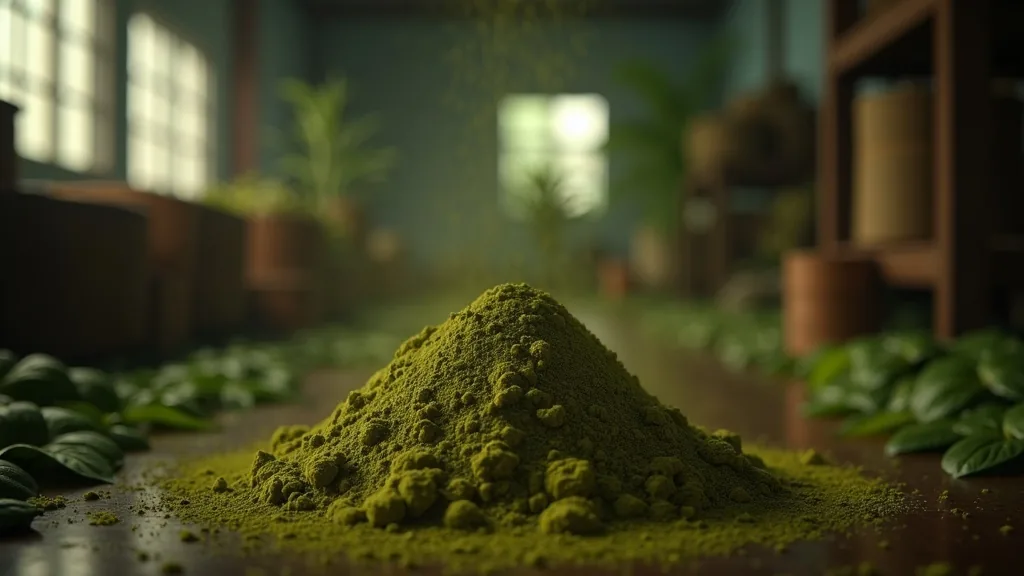
Indonesia supplies an estimated 90 to 95 percent of the world’s kratom (Mitragyna speciosa) entering international trade, according to industry shipment data and multiple sourcing reports — no other producing country comes close. That range, rather than one fixed number, is the accurate answer to one of the most common questions we get from new B2B buyers: how much of the world’s kratom does Indonesia supply? The short version is “the large majority of it,” but understanding why no government or trade body publishes one audited global figure matters for anyone building a supply chain around this product.
How Much of the World’s Kratom Does Indonesia Supply?
Trade researchers and industry associations consistently put Indonesia’s share of the global kratom supply at roughly 90-95%, with the bulk of that volume grown, dried, and processed on the island of Borneo, particularly in West Kalimantan. Even brands headquartered in the United States or the Netherlands that market their own “house” kratom powder are, in almost every case, repackaging leaf material that originated in Indonesia. So when people ask how much of the world’s kratom does Indonesia supply, the more useful framing is: Indonesia is not just a major supplier, it is close to the default origin point for the raw material behind the entire global trade.
Why There’s No Single Official Export Number
Kratom does not have its own dedicated customs (HS) subheading in most trading nations, including Indonesia. Shipments are typically recorded under broader “other plant material,” dried herb, or general botanical export codes shared with dozens of unrelated commodities. That means customs statistics cannot be filtered cleanly for “kratom” the way they can for, say, coffee or rubber. A second factor is history: formal exporter registration for kratom in Indonesia is recent. Before Indonesia’s Ministry of Trade introduced dedicated kratom export regulation in September 2024, much of the trade moved through general herbal-export channels with limited product-specific reporting, which is part of why estimates of exactly how much of the world’s kratom Indonesia supplies vary from source to source rather than converging on one number.
Industry monitoring covering the period from December 2024 through November 2025 — the first full window under the new registration rules — recorded roughly a hundred documented export shipments moving through a limited pool of licensed exporters to dozens of overseas trading partners. That kind of data is a meaningful signal of scale, but it still is not a complete customs census, so treat any specific tonnage figure you encounter, including ours, as a directional estimate rather than an audited total.
West Kalimantan’s Role in Indonesia’s Kratom Supply
A large share of the volume behind Indonesia’s global kratom supply traces back to West Kalimantan, where Mitragyna speciosa grows both wild and under smallholder cultivation along the Kapuas River basin. Farmers and local collection points harvest and sun- or shade-dry the leaf before it moves to regional processing hubs for grinding, sieving, and quality sorting. Because so much of the country’s export-grade material is grown and processed in this one province, its farming calendar, labor supply, and processing capacity have an outsized effect on national supply and on how consistently overseas buyers can secure the grades they need. For a closer look at how origin, grading, and processing capacity work together in this region, see our overview of West Kalimantan kratom origin, grades, and supply capacity.
Where Does Indonesia’s Kratom Export Volume Go?
The United States is the single largest destination market for Indonesian kratom by volume, a position it has held for years even as individual states have moved in opposite directions on legality. We cover the sourcing side of that route, including QC expectations and logistics realities for US-bound wholesale orders, in our guide to Bali kratom wholesale export to the USA. The European Union is a smaller but strategically important secondary market, complicated by the fact that individual EU member states set their own rules rather than following one bloc-wide policy — we break that landscape down for import-side buyers in our Indonesia-EU kratom trade overview for B2B importers. Smaller volumes also move to other Asia-Pacific and North American markets, though public trade data on those routes is thinner still.
Is Kratom Legal? A Snapshot by Region (2026)
Legal status is the single biggest variable in this trade, and it is genuinely a patchwork rather than one global rule. The table below reflects publicly reported status as of mid-2026. Laws in this space change quickly at the state, national, and regional level — always verify current rules with your own legal counsel and customs broker before committing to a shipment.
| Region | General Status (per 2026) | Key Detail |
|---|---|---|
| United States | Legal at federal level | No federal ban, but banned or restricted in a number of states (including Alabama, Arkansas, Indiana, Louisiana, Vermont, Wisconsin, and others); several states instead regulate it via Kratom Consumer Protection Acts covering age limits, labeling, and testing. |
| European Union | No bloc-wide rule; country-by-country | Reported as controlled or banned in a number of EU/EEA reporting countries (including Denmark, Sweden, Poland, Estonia, Finland, France, Italy, Latvia, Lithuania, Portugal, and Romania); status in other member states remains looser and subject to change. |
| Australia | Banned nationally | Classified as a prohibited (Schedule 9) substance across all states and territories; import and possession carry criminal penalties. |
| Indonesia | Legal to grow and trade domestically; export regulated | Export formally regulated since September 2024 under Ministry of Trade rules; only finely powdered/crushed kratom may be exported, not raw leaf or coarse material. |
This table is a starting point, not a compliance guarantee. We do not provide legal advice, and we do not promise customs clearance in any destination — that determination rests with the importer, their broker, and the receiving country’s authorities.
What Indonesia’s 2024-Onward Export Rules Mean for Buyers
Since September 2024, kratom export from Indonesia has been governed by Ministry of Trade regulations (Permendag No. 20 of 2024, amending the prohibited-export-goods list under Permendag No. 22 of 2023, alongside Permendag No. 21 of 2024). The core rules that matter for wholesale buyers:
- Only finely crushed or powdered kratom (commonly specified under roughly 600 microns) may leave the country — whole leaf and coarse crumb are not export-eligible.
- Exporters must hold Registered Exporter (ET) status, secure an Export Approval (PE), and provide a Surveyor’s Report (LS) for each shipment.
- Export-grade material must meet baseline standards covering freedom from microbiological contamination, heavy metals, and foreign plant matter.
Domestic policy is still evolving on the consumption side — Indonesia’s Ministry of Health, BRIN, and BPOM have continued researching how kratom should eventually be classified for internal use, and public statements as recently as early 2025 described parts of the framework as still unsettled. Treat this as a genuinely moving target: verify current export rules directly with your supplier and, ideally, an Indonesian trade or customs advisor before finalizing any purchase order, rather than relying on any single article, including this one, as a static reference.
QC Standards to Expect From a Serious Wholesale Supplier
Because export approval is now tied to quality documentation, batch-level testing has become standard practice rather than a nice-to-have. Buyers evaluating suppliers should expect, at minimum:
- Microbiological testing, including salmonella screening, on a per-batch basis.
- Heavy metal panels covering lead, arsenic, cadmium, and mercury.
- Moisture content and particle-size verification consistent with export regulations.
- A Certificate of Analysis (COA) tied to a specific harvest lot and traceable origin region.
None of this is a statement about effects, benefits, or suitability for any particular use — this article is strictly about trade volume, sourcing geography, and export compliance, not health claims of any kind, and nothing here should be read as one.
Sourcing Indonesian Kratom Responsibly
For import businesses, the practical takeaway from all of the above is straightforward: Indonesia’s dominant share of the world’s kratom supply is well established even if the exact percentage is debated, the regulatory environment on both the export side (Indonesia) and import side (your destination market) has shifted meaningfully since 2024, and working with a supplier that treats documentation, lab testing, and current-rules verification as standard practice — rather than an afterthought — is the difference between a smooth shipment and a costly one. Whichever estimate you use, how much of the world’s kratom Indonesia supplies is rarely in dispute: it is the clear majority, by a wide margin, even as the precise figure keeps shifting alongside the trade’s own reporting systems.
Bali Kratom Export is part of Juara Holding Group, operating from Bali across Indonesia since 2015. We work directly with growers and processors, including in West Kalimantan, and we’re upfront about what we can and cannot promise — including on regulatory questions, which we always direct buyers to verify independently for their own destination market.
If you’re evaluating Indonesia as a wholesale kratom source and want current lab documentation, shipment specifications, or logistics details for your market, reach our BD team directly on WhatsApp or by email at [email protected].